
Good HR Is Your First Line of Good PR
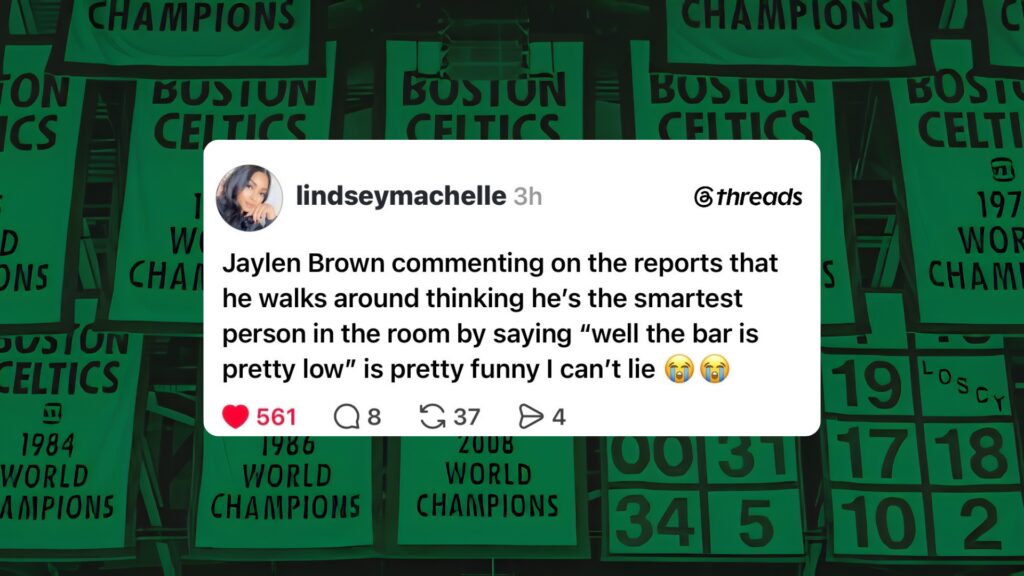
If you came here to talk about Jaylen Brown going live on Twitch during a playoff game, you need this article the most.
Because the story everyone is telling about the Celtics and Jaylen Brown is the wrong story. People want to talk about bad optics and streaming and whether he was a problem in the locker room. That is the surface read. That is the version for people who do not understand how organizations actually fail.
I do this for a living. What happened in Boston over the last few months is one of the most expensive HR failures I have seen play out in public in a very long time.
Let me tell you what I mean.
Before we talk about the trade, who Jaylen Brown actually is
Before we talk about what the Celtics did wrong, let me tell you who Jaylen Brown actually is. If you do not understand that, none of this lands the way it should.
The on-court résumé
The Celtics drafted him third overall in 2016. Ten years followed in a Boston uniform. He sits third all-time in franchise history in three-pointers made. Only five players in the entire NBA over the last four seasons (Brown, Tatum, Jokic, Anthony Edwards, and Luka Doncic) have posted 6,000 points, 1,500 rebounds, 900 assists, 300 steals, and 100 blocks. The 2024 title season made him Finals MVP, averaging 20.8 points, 5.4 rebounds, and 5 assists when it counted most. Eastern Conference Finals MVP came the same run.
The season the Celtics traded him
This past season, the one supposed to be a rebuilding year, he averaged 28.7 points, 6.9 rebounds, and 5.1 assists. First-time All-Star starter. Sixth in MVP voting. Five All-Star selections total. He was carrying the franchise.
Off the court, he signed his $304 million contract extension not at a press conference, not in front of cameras, but at MIT’s Media Lab in front of over a hundred students from Dorchester and Roxbury who were attending his Bridge Program. Think about that. The man had just secured the largest contract in Celtics history and he spent the day with kids learning about robotics and artificial intelligence instead of doing media.
The Boston community infrastructure
His 7uice Foundation partnered with the Museum of Fine Arts in Boston to run workshops where teenagers explore art, restorative justice, and tour the conservation center. At Fenelon Street Playground in Dorchester, he transformed the basketball court, partnering with the city’s Parks Department and holding a design competition won by a Northeastern University student. He showed up and painted the court himself.
In August 2024, he launched Boston XChange with a stated goal of generating five billion dollars in new net wealth for historically marginalized communities in Boston. Grants up to $100,000. Real mentorship. Real workspace. The Massachusetts House approved a $700,000 state budget earmark for his foundation this past April.
This is the person the Celtics decided did not deserve a phone call.
What actually happened with the trade
Here is what happened, for the people still catching up.
The Celtics were quietly shopping Jaylen Brown as part of their pursuit of Giannis Antetokounmpo. That information leaked. Jaylen Brown found out the way the rest of us did. Not through his general manager. Not through a conversation. Through the news cycle.
Once it became public, outside observers described the relationship as beyond repair. The organization’s response was not to repair it. It was to move faster. Brad Stevens traded him to Philadelphia, the team that had just eliminated the Celtics from the playoffs, for Paul George, two first-round picks, and two second-round picks. Critics universally panned the return. Multiple outlets called it baffling. Multiple executives around the league agreed.
Brown said publicly: “I wasn’t thrilled with the way he facilitated some of the conversations. I’m still processing it all because of how everything kind of went down.”
Your Finals MVP. Still processing. Because of how it went down.
That sentence is a press release. It just was not written by the Celtics communications team.
Why this is an HR story, not a basketball story
This is the part where I stop talking about basketball.
A belief lives inside most organizations, and it is costing them enormously: that public relations happens in a press release, on a stage, or in a crisis communication meeting. That it is a function you manage after the fact. That your brand is what you say about yourself.
It is not. Your brand is how you treat people when the decision is inconvenient.
Industry research consistently shows the pattern. Only 45 percent of employees who leave a job are satisfied with how their exit was handled. 42 percent say they felt undervalued during the process. Here is the number that should live on a poster in every executive conference room: employees who have a positive exit experience are 2.9 times more likely to recommend the company to others. Not just as a place to work. As a place that treated them like a human being. SHRM and other HR bodies have documented this trend across sectors.
83 percent of job seekers research a company’s reputation before deciding where to apply, according to LinkedIn Talent Solutions. 72 percent of HR professionals say offboarding directly impacts employer brand. The exit is not the footnote. It is often the headline.
The Celtics just wrote one.
Good HR is the function inside an organization that pulls a leader aside before the story leaks and says: you need to have this conversation. Not because it will be comfortable. Because every day you avoid it, it gets more expensive. This is exactly the pattern we address in our 4 triggers that tell you it is time for outside HR playbook.
Nobody did that here. Or if someone did, leadership did not listen. Either way, the organization paid for it. And they are going to keep paying.
The internal damage: what the roster just learned
First, the internal damage hit first. Every player on that roster watched how one of the most decorated players in franchise history got handled on his way out. They are not forgetting that. Trust inside an organization does not disappear overnight. It drains slowly, quietly, until one day you realize the room does not feel the same and you cannot trace it back to a single moment. Harvard Business Review has written extensively on how employee experience decisions cascade through morale over months, not days.
The external damage: how reputation compounds in recruiting
Also, the external damage is going to run longer.
A few years ago, when the Celtics were pursuing Anthony Davis, his father said publicly that he would never let his son come to Boston after what they did to Isaiah Thomas. Isaiah Thomas played through a catastrophic hip injury, gave this city everything he had, and found out about the trade while in rehab. That was years ago. People still remember it. That is how reputation works. It does not refresh. It compounds.
How many agents just updated their files on Boston? How many parents of elite prospects watched a five-time All-Star and MVP candidate find out through a news leak that he was being shopped, and then get sent to the team that just knocked his team out of the playoffs, and quietly made a note? You do not always know when you lose a candidate. That is the part that should scare organizations. The calls that never come.
89 percent of HR leaders say a strong employer brand gives them a competitive advantage in attracting talent. The inverse is equally true and considerably more expensive.
The community piece: what the Celtics cannot trade
And the community piece. I want to stay here for a minute because this is not getting enough attention.
Jaylen Brown is not embedded in Boston the way most professional athletes are embedded in a city.He is not a sponsor. Not a logo on a jersey. What he built is real infrastructure in communities the organization he played for has never meaningfully touched.
The 7uice Foundation. His Bridge Program at MIT. A partnership with the Museum of Fine Arts. That Dorchester basketball court he painted with his own hands. Boston XChange, trying to generate five billion dollars in generational wealth. And a $700,000 state budget earmark from Massachusetts.
After the trade, he said: “Basketball can take you in different directions, but purpose doesn’t.”
He is staying in Boston to run his nonprofits. Let that sit for a moment. The man they traded is staying in the city they play in.He will be at community events. In Dorchester. At the MIT Media Lab with the next cohort of students.
Every time someone from Boston sees him, they are going to remember what the Celtics did and how they did it.
The organization does not get to trade the community relationship. That stays with him.
How the same trade could have been made differently
They could have still traded him. I want to be clear about that. Organizations make roster decisions. That is not the problem. The problem is that the exact same decision can play out two completely different ways, and only one of them leaves your reputation intact.
A phone call to Jaylen was one option. An honest conversation was another. Someone could have said here is where we are, here is what we are thinking, here is why, and here is what we want to do. Ten years of service deserved a real conversation. The trade could have gone through the same way, for the same return, without making the Finals MVP tell the world he was still processing how it went down.
Leadership did not want to do the work. That is the entire story. Our handbook and process work exists to make sure that when a hard conversation is coming, the operator is not making it up on the fly.
This pattern is not unique to professional sports
This is not unique to professional sports. I see it inside companies constantly. Leadership decides to make a move. The conversation is going to be hard. The person is not going to be happy. So the leader manages around it. The delay begins. The situation develops in ways that feel easier than being direct. Then it blows up. The communications team gets called in. Suddenly the leadership is dealing with a problem that a single honest conversation would have prevented.
Good HR is not a compliance function. It is not a paperwork function. It is not the team you call when something goes wrong. Good HR is the discipline of treating people well enough, consistently enough, that the crisis never needs a response because it never becomes a crisis. Our cannabis termination playbook exists for exactly this reason: to keep the hard conversation from becoming a lawsuit six months later.
78 percent of employees say how a company handles their exit impacts their likelihood to recommend it. 72 percent of HR professionals say offboarding directly affects employer brand. These are not soft metrics. These are brand metrics, recruiting metrics, and over time, revenue metrics.
How you exit people is your PR
How you exit people is your PR. The way you handle the hard conversations is your PR. What your Finals MVP tells the world about how it went down is your PR.
So, the Celtics found that out this week. Similarly, a lot of organizations are going to find that out this year.
Jaylen Brown gave Boston ten years, a championship, a Finals MVP, a $700,000 state earmark for youth education, a Dorchester basketball court, a partnership with the Museum of Fine Arts, and a $5 billion wealth-building initiative for marginalized communities in the city that still needs fans to buy tickets.
He said purpose does not move.
Meanwhile, the organization that traded him might want to figure out what theirs is.
What operators should do this week
If you are running an operation of any size, three things this week.
First, look at your offboarding process. Is there a documented conversation script for a difficult exit? Is there a designated leader who is responsible for delivering the message in person, on time, and with dignity? If either is missing, that is your next hire or your next process fix.
Second, audit the last three exits from your organization. Not the smooth ones. The hard ones. Ask yourself: would the person who left say they were treated with respect? If you cannot answer that question honestly, ask the person. Their answer tells you exactly what your former employees are telling candidates about you right now.
Third, if you are heading into a hard people decision this quarter, do not delay it. Do not manage around it. Book the conversation on the calendar. Have it. The cost of an honest, timely conversation is uncomfortable. The cost of the alternative is measured in the calls that never come. Multi-state operators especially should pressure-test their process; see our multi-state cannabis HR playbook for why regional differences amplify the cost of a bad exit.
If you want a set of experienced HR eyes on your offboarding or your hard-conversation process, book a 15-minute call. We will look at what you have and tell you which step is the weakest. That is what fractional HR is supposed to do.
Celtics, give us a call. You clearly need us.
Editor's note
This post is informational and reflects patterns we have seen across the 50+ cannabis operators we work with. It is not legal advice. Federal drug testing, DOT compliance, and immigration rules interact in complicated ways and change frequently. Consult licensed employment counsel and immigration counsel before making hire or fire decisions involving federally-regulated workers.
July 7, 2026
Kim Bruen


Be the first to comment